SeedLabs
SeedLabs
SeedLabs is the environmental research division of Seed Health. Founded on the notion of One Health—that human health and environmental health are intertwined and interdependent—we advance emergent environmental research and microbial innovations to recover ecosystems impacted by human activity and address some of the greatest challenges presented by climate change.
02
Carbon Dioxide
Tapping into the power of microbes for novel solutions to CO2 emissions.
Microbes have evolved for at least 3.5 billion years; some thrive in extreme, high-CO₂ environments such as hydrothermal vents. 2FP hypothesized that the places with the most CO₂ on Earth might host organisms best at consuming it.
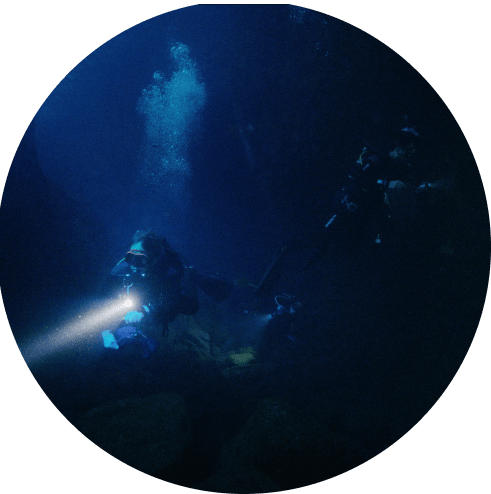
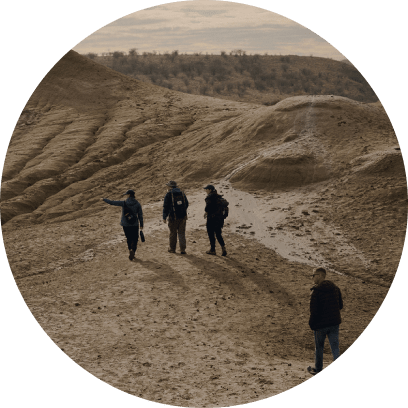
Status of Research: four global expeditions — CARBON1 (Aeolian Islands, Italy), CARBON2 (Colorado, USA), CARBON3 (Aeolian Islands underwater seeps), CARBON4 (Shikinejima, Japan). A previously unknown, highly efficient CO₂-consuming microbe nicknamed ‘Chonkus’ was characterized and published in Applied and Environmental Microbiology.
03
Methane
Studying microbial approaches to capturing and transforming methane at scale.
Methane’s warming potential is 86× that of CO₂ over 20 years, yet it persists only 10–12 years in the atmosphere—so cutting CH₄ delivers fast climate benefits. Methanotrophs are microbes that metabolize methane as an energy source.
Status of Research: two expeditions — METHANE1 (Scoglio d’Africa, Italy) and METHANE2 (Buzău, Romania). Samples are in laboratory analysis.
04
Coral
Using microbiology to increase reef resilience.
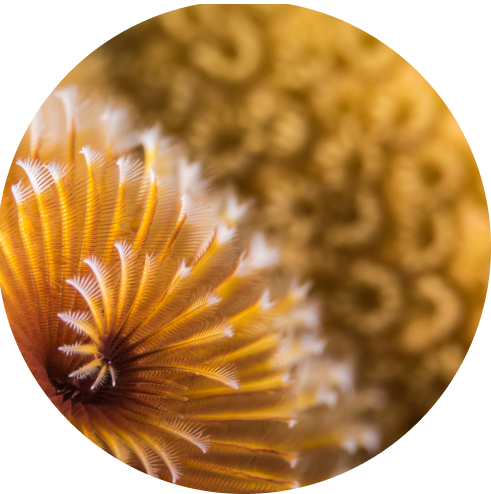
Coral reefs support 25% of marine life. Corals function as holobionts—host plus algae, bacteria, archaea, fungi and viruses operating as one. Heat, acidification, pollution and disease break that symbiosis and cause bleaching.
Status of Research: Carbon Stress sampling in Sicily and Japan, plus Coral Probiotics work with Raquel Peixoto, PhD at KAUST in a dedicated underwater ‘Coral Probiotics Village’ in the Red Sea.
05
Soil
Partnering with microbes to restore soil health and productivity.
Healthy soil is alive with bacteria, fungi and protozoa that break organic matter into plant-available nutrients. Our partners work to protect and rebuild soil microbial networks.
Status of Research: with SanaTerra One Health & Microbiome Living Lab, we are studying microbially-driven composting in Villanueva de la Vera, Spain, using manure from the endangered Verata goat. Results expected in early 2027.
06
Honey Bees
Developing probiotics to improve honey bee resilience.
The western honey bee pollinates nearly a third of global food crops, yet populations are declining from pesticides, climate change, disease and habitat loss. Dr. Gregor Reid and Dr. Brendan Daisley identified three probiotic strains: Lactiplantibacillus plantarum Lp39, Lacticaseibacillus rhamnosus GR-1, and Apilactobacillus kunkeei BR-1.
Status of Research: three field trials since 2018, including the largest honey bee probiotic trial to date. Results published in ISME Journal (2023).
07
Plastics
Growing bioengineered bacterial strains to reduce plastic waste on space missions.
Plastic accumulation is a planetary crisis — and it reaches orbit, where astronaut waste piles up inside spacecraft. In 2022 SeedLabs supported MIT Media Lab Space Exploration Initiative, the National Renewable Energy Laboratory and Harvard Medical School in building an autonomous bioreactor that depolymerizes single-use PET and converts it with engineered Pseudomonas putida into β-ketoadipic acid (BKA), a high-performance nylon monomer.
Status of Research: launched to the ISS on November 26, 2022; 43 days in orbit; published in npj Microgravity.